
Table of Contents
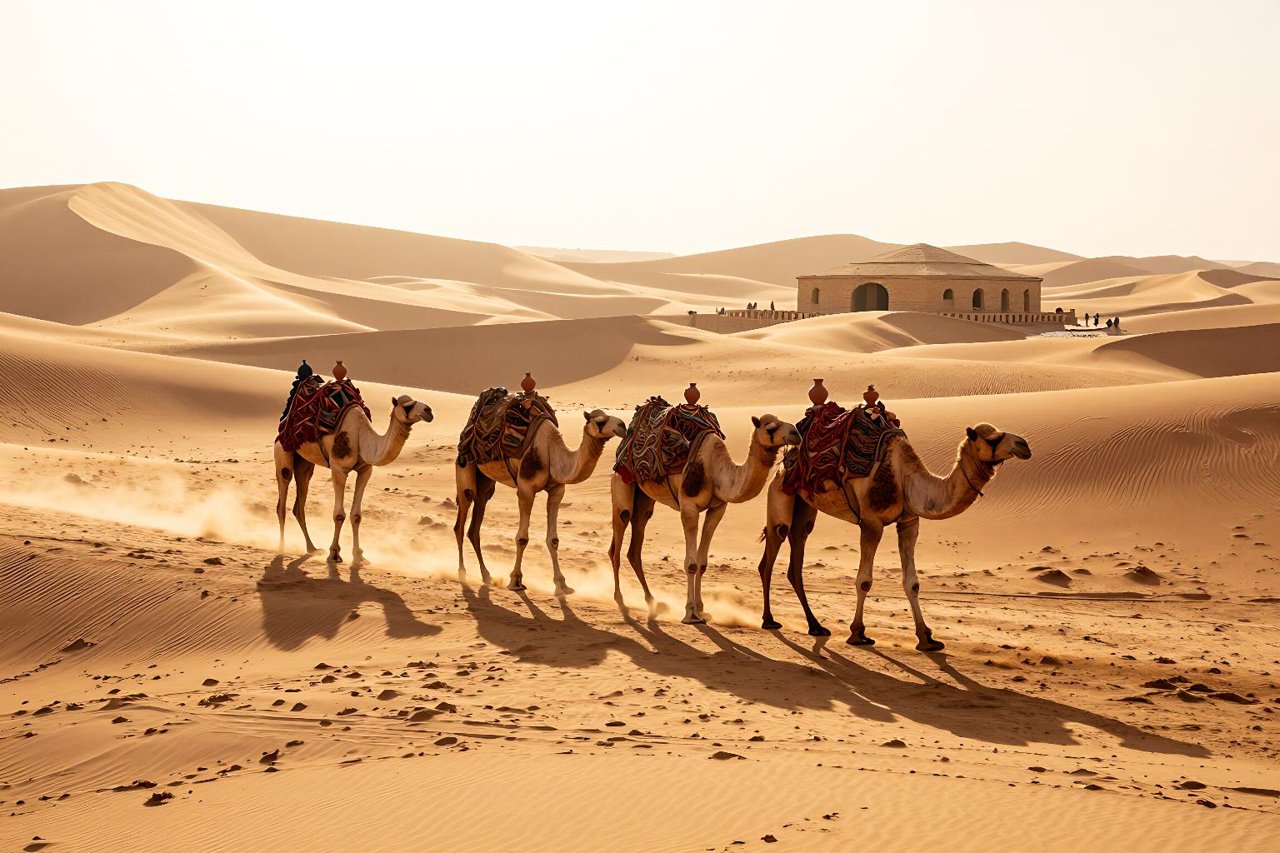
In the first century AD, a caravan left the Nabataean city of Petra for Gaza carrying frankincense, myrrh and a small fortune in silver. The trip took weeks. Sandstorms, bandits and a tax collector in every town took their cut. Nobody on that road thought of themselves as part of a global system, yet the incense burning in Roman temples, the silk on a senator’s wife and the pepper in a legionary’s stew all moved along the same handful of corridors. Goods were only the beginning. Gods, languages, recipes, germs and inventions travelled the same tracks.
Modern trade moves in containers and clearing systems. Ancient trade moved at four kilometres an hour, and that pace shaped everything about it: cargo size, the number of middlemen, and how far an idea could spread before it turned into something new.
The Silk Road Was Never One Road
The name is younger than the route. Ferdinand von Richthofen coined Seidenstraße in 1877, long after the traffic had faded. What he labelled was really a shifting web of tracks stretching roughly 6,400 kilometres from Chang’an to the Mediterranean, with branches peeling off into Persia, India and the steppe.
Almost nobody travelled the whole thing. A merchant might carry jade from Khotan to Dunhuang, sell it, and go home. The next trader took the same bales west. Silk reached Rome after passing through a dozen hands, which is why Pliny the Elder grumbled that the empire was bleeding silver eastward for a fabric it never saw being made.

Caravanserais: the infrastructure that made it work
Caravanserais held the network together. These fortified inns were spaced roughly a day’s walk apart and offered water, fodder, a locked storeroom and a courtyard for the animals. Many were funded by rulers who understood a simple economic truth: safe roads generate taxable trade. The system worked well enough that papermaking reached Baghdad in the eighth century, and the inventions ancient China got to first — paper, printing, the magnetic compass — eventually reshaped Europe.
The Incense Route: Perfume Worth More Than Gold
Before petroleum, the Arabian Peninsula’s most valuable export came from trees. Frankincense and myrrh were tapped from Boswellia and Commiphora in what is now Oman and Yemen, then hauled about 2,400 kilometres north to Gaza and Damascus. The Nabataeans controlled the middle stretch and grew rich enough to carve a city out of sandstone.
Demand was religious and social rather than practical. Temples burned incense daily. Funerals required it. A household with status smelled of it. Because the source was so tightly controlled and the journey so long, a kilo of resin could cost more than a kilo of silver in Rome. The route’s real legacy is a chain of ruins, including ancient cities that keep rewriting what we assume about the past, strung from the Negev to the Syrian desert.
Salt, Gold and the Sahara’s Camel Roads
The trade routes that changed the world didn’t all run east. South of the Sahara, a network of caravan trails linked the goldfields of West Africa to the Mediterranean coast. Camel trains of a thousand animals left Timbuktu and Awdaghost for the salt pans of Taghaza and the markets of Sijilmasa, crossing a thousand kilometres of dune and gravel in around ninety days.
Salt made the whole thing viable. Slabs from Taghaza were so essential for preserving food and keeping livestock alive that medieval accounts describe them trading weight for weight with gold. That may be flattery, but the imbalance tells you something: a place with nothing but salt could do business with a place that had nothing but gold, because each needed the other.
The Northern Roads: Amber and Tin
Not every famous route carried spices. Amber travelled from the Baltic coast south to the Adriatic along a loose collection of trails known as the Amber Road. Pliny, again, complained about the price: a small amber figurine, he wrote, cost more than a healthy slave. Roman coins from the first and second centuries still turn up in Poland and the Baltic states.
Further west, tin from Cornish streams fed the bronze workshops of the Mediterranean long before Roman legions arrived. Bronze needs copper and tin in the same crucible, and the two almost never occur together. A tin valley in Britain and a foundry in Cyprus were economically bound three thousand years ago.
Monsoon Winds and the Spice Sea
The Indian Ocean was the quiet giant. Sailors had hugged the coast for centuries until someone, credited by Pliny to a captain named Hippalus, worked out that the monsoon blows reliably one way in summer and the other in winter. A ship could then cross from the Red Sea to the Malabar Coast in weeks rather than months of coastal crawling.
Strabo, writing around the turn of the first millennium, noted that roughly 120 ships a year were sailing from Myos Hormos to India. They came back with pepper, gems and cotton; they left with wine, glass and coin. Hoards of Roman denarii buried in southern India count among the ancient artifacts that changed history, because they prove the trade deficit sometimes ran the other way.
Control of that sea traffic was still worth fighting over a thousand years later. The Crusades were a holy war and a trade war at once, and the Italian city-states that ferried crusaders east kept a grip on the Mediterranean spice monopoly for generations afterwards.
The Grand Trunk Road
One route has been in continuous use for more than two thousand years. The Grand Trunk Road runs roughly 2,500 kilometres from Kabul over the Khyber Pass, through Peshawar, Lahore and Delhi, and on toward Chittagong. Chandragupta Maurya’s engineers built the first version. Sher Shah Suri rebuilt it and planted shade trees along its length in the 1540s. It is still a working highway.
What Actually Travelled
Cargo is the least interesting thing that moved. Consider the rest.
- Religions. Buddhism spread from India to China and Japan through the Silk Road’s oasis towns. Islam reached Mali with Saharan traders and Indonesia with Gujarati merchants.
- Technology. Paper and gunpowder went west. The lateen sail and Indian numerals moved in every direction. The number system you use to read a price tag came down a trade route.
- Disease. The plague that struck Constantinople in 541 arrived with grain ships from Egypt. The Black Death reached Europe in 1347 aboard Genoese galleys from the Black Sea.
- Food. Bananas, sugar cane, citrus, rice and cotton all migrated along the same corridors, then kept going.
- Language and law. Koine Greek served as the common tongue of eastern Mediterranean commerce for centuries, and the ideas and language of ancient Greece travelled alongside the amphorae.
Where the Old Routes Still Run
You can trace most of them from a kitchen shelf. Pepper came by sea from Kerala. Salt came over the Sahara and out of English brine springs. Sugar moved from New Guinea to India to Persia to the Mediterranean. Cumin arrived in Europe through the same Levantine ports as frankincense. The word “salary” is a fossil of the salt trade, and “traffic” once meant the toll you paid to move goods, not the queue on a ring road.
Institutions survived too. The caravanserai became the roadside inn, which became the motel chain. The bill of exchange that let a Florentine merchant pay a partner in Bruges without shipping coins is a direct ancestor of the bank transfer you make on a phone. Insurance, contracts and customs duties all grew up because a consignment of silk had to be trusted to strangers thousands of kilometres away.
Empires came and went. The roads stayed, mostly because geography is stubborn, and mountain passes, river crossings and reliable winds have changed very little in two thousand years. The ancient trade routes reshaped the world slowly, one caravan at a time, and the map of global commerce still carries their outlines.


