
Table of Contents
Ask ten people what healthy eating looks like and you’ll get ten confident answers. Keto. Vegan. Fasting until noon. Cutting out gluten for no particular reason. Underneath all the noise, the research on healthy foods and nutrition is remarkably consistent, and far less dramatic than any of those answers suggest.
The short version goes like this: eat mostly plants, get enough protein, don’t fear fat, keep added sugar and ultra-processed snacks occasional, and eat roughly the right amount for your body. The hard part isn’t knowing this. It’s doing it on a Tuesday evening when you’re tired and the supermarket is full.
What healthy eating looks like on a plate
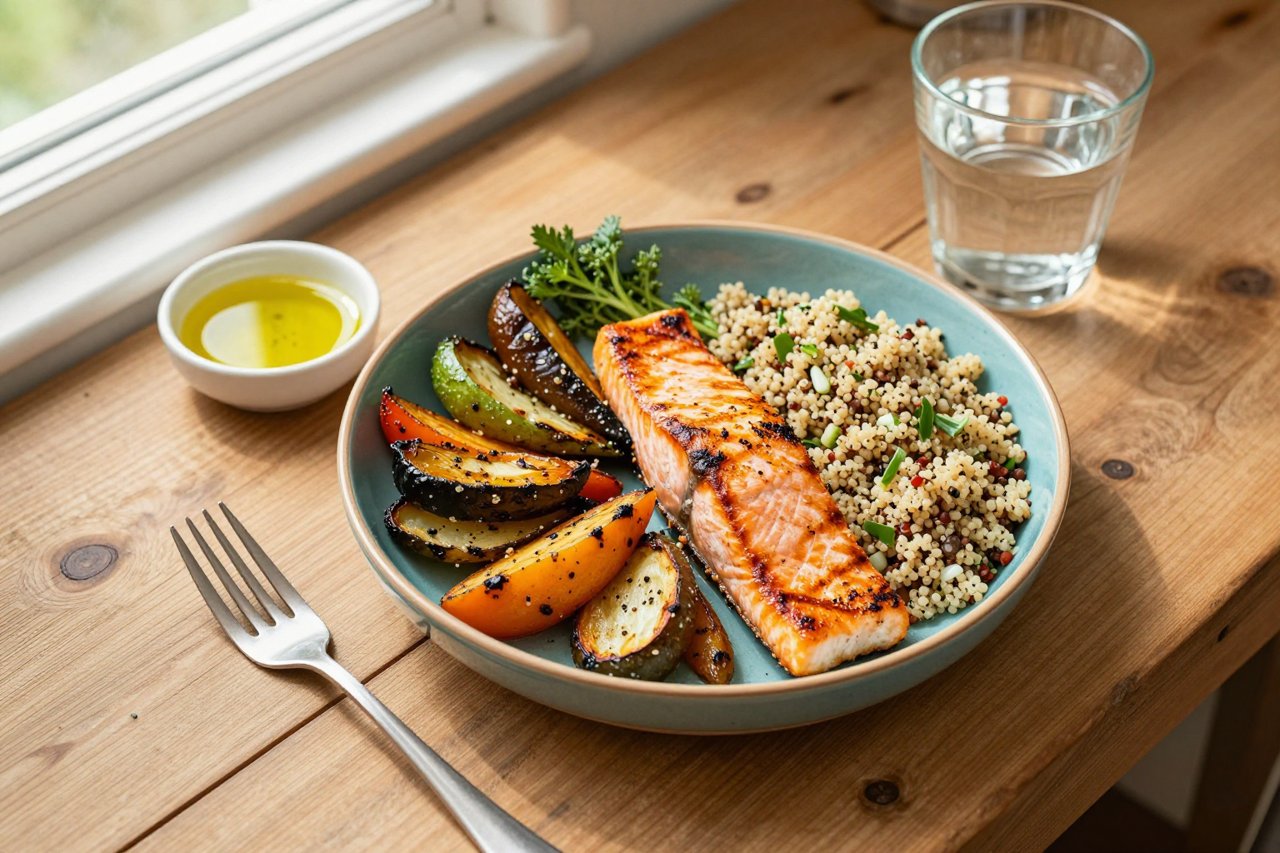
Nutrition advice turns vague fast, so let’s be specific. A well-built meal usually has four components: a large volume of vegetables, a solid source of protein, a slower-digesting carbohydrate, and some fat.
That combination delivers fibre, protein, vitamins, fat and energy in proportions your body handles well. It also keeps blood sugar steadier than a plate of plain white pasta with nothing alongside it, which matters whether or not you have a diagnosed condition.

Five categories worth building meals around
Vegetables and fruit
Aim for roughly five portions a day, where a portion is about 80g. That’s a banana, a handful of berries, three heaped tablespoons of peas. Frozen counts just as much as fresh, and tinned tomatoes or a bag of frozen spinach are perfectly good nutrition that costs very little.
Variety does help, since different pigments carry different polyphenols. Volume matters more, though. A big bowl of frozen mixed vegetables beats an expensive bunch of organic kale that wilts in the drawer while you order takeaway.
Protein
Protein keeps you full, protects muscle as you age, and takes real effort to digest. The baseline recommendation sits around 0.8g per kilogram of body weight, but active adults generally do better at 1.2 to 1.6g. For someone weighing 70kg, that’s roughly 84g to 112g a day.
Chicken, eggs, fish, Greek yogurt, cottage cheese, lentils, beans, tofu and edamame all do the job. If you’re weighing up options, this side-by-side look at chicken, lentils and Greek yogurt breaks down grams per serving, cost and what each one is genuinely good for.
How you spread protein across the day matters too. Three meals with 30g each beats 90g crammed into dinner, especially for muscle repair after 40. Breakfast is where most people fall short, which is one of the common protein mistakes that quietly sabotage a diet.
Whole grains and starchy carbohydrates
Oats, barley, brown rice, wholewheat pasta, quinoa, potatoes with the skin on and sweet potatoes all belong here. Carbohydrates aren’t the villain; large amounts of refined carbs eaten alone are the problem.
If you’re managing blood sugar, the company your carbs keep changes the glucose response significantly. Pairing them with protein, fat and fibre slows digestion, and there are nine blood sugar mistakes worth knowing if that’s a concern for you.
Fats
Olive oil, nuts, seeds, avocado and oily fish such as salmon, mackerel or sardines twice a week. These support heart health, hormone production and vitamin absorption. Saturated fat isn’t poison, but it’s worth keeping to a modest share of your total intake rather than the centrepiece.
Fermented and fibre-rich extras
Live yogurt, kefir, kimchi, sauerkraut and tempeh feed the gut bacteria that influence digestion, immunity and mood. Research from the American Gut Project found that people eating 30 or more different plant foods a week had noticeably more diverse gut microbes than those eating ten or fewer. Diversity, not perfection, is the goal.
Zoom out further and these choices compound over decades. The patterns that show up repeatedly in long-lived populations are covered in this guide to foods for longevity.
Portion sizes without weighing anything
You don’t need a food scale. Your hands scale with your body, which is why dietitians have used them for years.
- Vegetables: two cupped hands, roughly 150g cooked
- Protein: one palm-sized portion, about 25 to 30g
- Carbohydrates: one cupped hand of cooked rice, pasta or potato
- Fats: one thumb of oil, butter or nut butter
That rough template is the basis of the plate method, which clinicians use with people managing type 2 diabetes. It sits alongside low-carb, Mediterranean and plant-based approaches as one of several workable frameworks, and this comparison of the plate method versus other dietary patterns explains where each one wins.
The label tells you more than the packaging
The front of a packet sells a feeling: natural, high protein, low fat. The back tells you what’s actually inside. Three things worth checking:
- Fibre per 100g. Six grams or more is genuinely good. Under two is mostly filler.
- Added sugar. Anything above roughly 10g per 100g deserves a second look.
- The ingredient list. If it runs to 25 items you can’t pronounce, it’s probably an ultra-processed product wearing a health halo.
Flavoured yogurts are the classic trap. A pot marketed as low fat can carry 12g of sugar per 100g, which is more than vanilla ice cream in some cases. Plain Greek yogurt with a spoon of honey gives you the protein without the sugar load.
Where people quietly go wrong
Most diets don’t fail because of one catastrophic habit. They fail through small, repeated ones. Skipping breakfast and then grazing all afternoon. Drinking 400 calories of smoothie and calling it a health kick. Treating olive oil as calorie-free when a tablespoon is around 120 calories. Snacking on cereal bars that are essentially confectionery.
Chronic inflammation is another area where food genuinely plays a role. If aching joints are part of your daily life, the eating strategies in this beginner’s guide to foods for arthritis are a sensible place to start.
A normal day that actually works
Nothing fancy, nothing Instagram-worthy:
- Breakfast: 80g oats with 200g Greek yogurt, a handful of frozen berries and 15g almonds. Around 25g protein and 9g fibre.
- Lunch: leftover roast chicken, quinoa, roasted vegetables, olive oil and lemon.
- Snack: an apple with 20g cheddar, or a bowl of steamed edamame.
- Dinner: salmon fillet, new potatoes, broccoli and a green salad.
That lands somewhere near 100g of protein and 30g of fibre, which is roughly double what the average adult manages. Most people in the UK and US get 15 to 18g of fibre a day against a 30g target, and closing that gap is one of the highest-return changes you can make.
Build fibre up gradually and drink plenty of water alongside it, otherwise you’ll spend a week feeling bloated and blame the vegetables.
Start with one meal, not a whole new identity
Overhauling your entire diet on a Monday morning rarely survives the first stressful week. Pick a single meal instead. Fix breakfast for two weeks until it’s automatic, then move to lunch. By week six you’re eating noticeably better and you never had to white-knuckle your way through it.
Aim for good enough most of the time. A roast dinner, a slice of birthday cake, a Friday takeaway: none of it undoes a week of solid meals. What undoes progress is the all-or-nothing cycle where one off-plan meal becomes an off-plan month. Consistency at 80% beats perfection at 20%, every single time.


