
Table of Contents
Walk down the snack aisle of any supermarket and you’ll count dozens of packages shouting the word PROTEIN at you from the shelf. Cereal bars, cookies, chips, popcorn, even gummy bears. Read the back of most of them and you’ll find the same thing: somewhere between 3 and 8 grams, wrapped in a lot of confident design work.
If you’re new to this, the whole category can feel like a puzzle where the pieces don’t fit. So here’s the ground-floor version. What a protein snack actually is, how much protein it needs to carry, and how to tell a genuinely useful one from a marketing exercise in about twenty seconds flat.
What Actually Counts as a Protein Snack
Almost everything you eat contains protein. Bread has it. Peanut butter has it. A granola bar has it, technically, in the same way a puddle has water. The question was never whether a snack contains protein. The question is whether that protein is doing any real work.
A simple working definition: a protein snack delivers at least 10 grams of protein in a portion you’d realistically eat in one sitting.

Why 10 grams is the floor
Around 10 grams of good-quality protein provides roughly the amount of leucine, an amino acid that acts like a light switch for muscle repair, needed to actually flip that switch. Below that threshold you’re mostly buying calories. Ten grams also tends to be the point where a snack starts holding you until your next real meal instead of just bridging twenty minutes.
This matters less if you’re sedentary and more if you’re lifting, running, or over 40, but the 10-gram bar is a reasonable line for almost everyone.
The test that matters more: protein per 100 calories
Grams alone can mislead you. A 20-gram protein bar with 320 calories is a completely different food from 20 grams of protein out of a tub of cottage cheese at 150 calories. The ratio tells you which one will fill you up and which one will leave you hunting the cupboard an hour later.
- Excellent (10g or more per 100 calories): tinned tuna, cottage cheese, plain Greek yogurt, sliced deli turkey, white fish
- Solid (7-10g): hard-boiled eggs, mozzarella string cheese, beef jerky, shelled edamame
- Weak (under 5g): peanut butter on its own, most granola bars, trail mix, hummus with crackers
Weak doesn’t mean bad. Peanut butter on a rice cake is a perfectly good food. It’s just not a protein snack. It’s a fat-and-carb snack that happens to carry a little protein along for the ride.
How Snacks Fit Into a Day of Protein
Most active adults land somewhere around 1.6 grams of protein per kilogram of body weight. For a 70kg person that’s about 112 grams a day. Picture trying to hit that across three meals: 37 grams at each one. Breakfast alone rules most people out.
That’s the gap snacks exist to fill. Three meals at 30 grams each gets you to 90. Two snacks at 15 grams each gets you to 120, and suddenly you’re at target without eating anything unusual. Same food, different distribution.
If you’re still working out your own number, be careful with the free tools. A handful of easy input errors can throw your target off by 20 grams or more, which is exactly the problem covered in these common protein intake calculator mistakes.
The Three Families of Protein Snacks
Every option on the market falls into one of three buckets, and each has a personality.
- Whole food: eggs, Greek yogurt, cottage cheese, jerky, tinned fish, edamame, hard cheese. Best satiety per calorie, usually cheapest, and nothing to decode on a label.
- Protein bars: shelf-stable and genuinely convenient. Quality varies enormously, from bars that are real food to bars that are a candy bar with a scoop of whey stirred in.
- Shakes and powders: the fastest 20-30 grams you’ll ever get, which makes them useful after training or on a train. Poor at satisfying actual hunger.
None of the three wins outright. We put them head to head on cost, fullness and convenience in this comparison of bars, shakes and real food, and the winner kept changing depending on where you were standing when hunger hit.
Reading a Label in Twenty Seconds
Skip the front of the pack entirely. Four numbers on the back tell you what you need:
- Protein per serving – looking for 10g minimum, 15-20g is comfortable
- Calories per serving – anything over 250 is a small meal, not a snack
- Sugar – under 10g is reasonable, and plenty of bars sail past 20g
- Fibre – 3g or more means it’ll actually stick with you
Then do one piece of mental arithmetic: divide protein grams by calories and multiply by 100. A bar with 20g protein and 200 calories scores a 10. A “protein” cookie with 8g and 260 calories scores a 3. Same shelf, same font, completely different foods. Manufacturers are very good at making the front of the box say what you want to hear, and this round-up of mistakes that make protein snacks useless walks through most of the tricks in detail.
Five Beginner-Friendly Protein Snacks to Start With
These are the ones worth keeping in rotation first. Each takes under two minutes and needs no cooking skill. Numbers are approximate.
- 170g plain Greek yogurt with a handful of frozen berries: 18g protein, about 140 calories
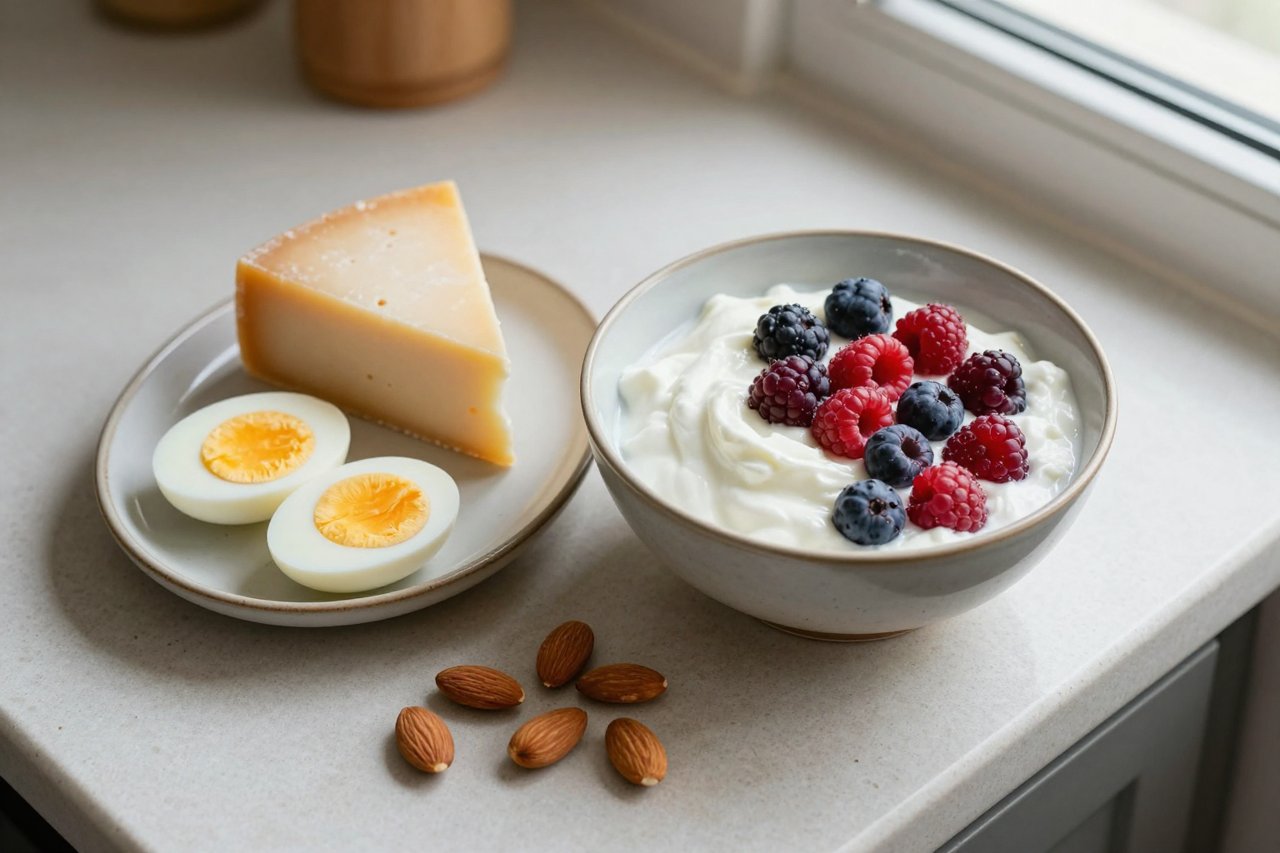
- Two hard-boiled eggs and a mozzarella stick: 19g protein, about 220 calories
- One tuna or chicken pouch with an apple: 17g protein, about 180 calories
- Half a cup of cottage cheese with tomato and cracked black pepper: 14g protein, about 100 calories
- A whey shake made with water plus a banana: 27g protein, about 230 calories
Boil six eggs on a Sunday and you’ve handled three days of snacking before the week starts. If you want more variety than that, there are 19 easy high-protein snack ideas that keep you full, most of which use ingredients you already own.
Timing, and the Boredom Problem
Total daily protein matters far more than the clock. That said, timing isn’t meaningless. A snack somewhere between 3pm and 4pm is the single highest-value one for most people, because that’s when the afternoon slump and the office biscuit tin team up. A shake within a couple of hours of training helps if you struggle to hit your number. Cottage cheese before bed is a long-standing favourite because casein digests slowly.
The bigger trap for beginners is eating snacks because they’re there. If you finished lunch forty minutes ago and you’re already back at the cupboard, that’s a habit, not hunger. A protein snack should be answering a real gap, which usually means it’s been three or four hours since your last proper meal.
And snacks don’t replace meals. If most of your protein is arriving in bar form, the fundamentals are worth revisiting. This beginner’s guide to getting high-protein meals right covers how to build the three plates that do the heavy lifting, so your snacks are topping up a solid day rather than patching a shaky one.
Your First Week: Keep It Stupidly Simple
Pick two snacks from the list above. Buy the ingredients on your next shop. Eat them at the same two points each day for one week, and change nothing else about how you eat.
Then check three things. Are you less hungry at 4pm? Is dinner portion naturally a bit smaller? Is your energy steadier through the afternoon? If you get two yeses, you’ve found snacks that work for you and you can start swapping in variety. If you get nothing, change the snack, not the entire plan.
Most people who make protein snacking stick don’t do anything clever. They find two or three options that taste good, keep them within arm’s reach, and stop thinking about it. The first week is just about finding out which two or three those are.


