
Table of Contents
The weather turns colder, and suddenly half your friends are asking about the best vitamin D supplement. Walk into any pharmacy and you’ll see why the question gets complicated: vitamin D3 from sheep’s wool, D2 from mushrooms, vegan lichen drops, softgels, sprays, tablets. Each option is useful, but they are not interchangeable. You need to compare the molecular form, the source, the delivery format and the dose before spending money. Here is a practical breakdown of the choices that actually matter.
D3 vs D2: The Difference That Matters
Vitamin D3 (cholecalciferol) is the closest match to what your body makes when sunlight hits your skin. Vitamin D2 (ergocalciferol) is made by exposing certain mushrooms or yeast to UV light. Clinical trials that compare equal doses of D2 and D3 generally find that D3 produces a bigger and more sustained increase in blood levels of 25-hydroxyvitamin D. This means that for treating or preventing deficiency, D3 is usually the better bet.
D2 is still added to many vegan milks and over-the-counter gummies, but it appears to clear the body faster and does not lift blood levels as consistently. If you have a serious deficiency and choose D2 anyway, be careful about relying on low doses. Your blood test tells you more than any marketing claim, and a good supplement starts with knowing your starting number. If you’d like a clearer system for evaluating a label, our step-by-step guide to finding the best vitamin D supplement can help you move through each factor in the right order.
Where Does D3 Actually Come From?
Most D3 on the market is derived from lanolin, a waxy substance purified from sheep’s wool. It’s a byproduct of shearing, so no sheep are killed, but strict vegans and vegetarians still prefer to avoid it. If you fall into that group, look for vitamin D3 made from lichen. Lichen D3 is biochemically identical to lanolin-derived cholecalciferol, but the extraction is more expensive. The price often reflects that cost, so don’t be surprised if a lichen version costs double or triple the price of a lanolin bottle.

For most people, lanolin-based D3 is perfectly safe and affordable. For those with a true allergy to raw lanolin or sheep wool, oral D3 is rarely triggering, but some brands use lanolin that might contain unwanted residues in less refined products. If you have this sensitivity, a lichen-based D3 eliminates the worry completely.
Drops vs Softgels vs Sprays vs Tablets
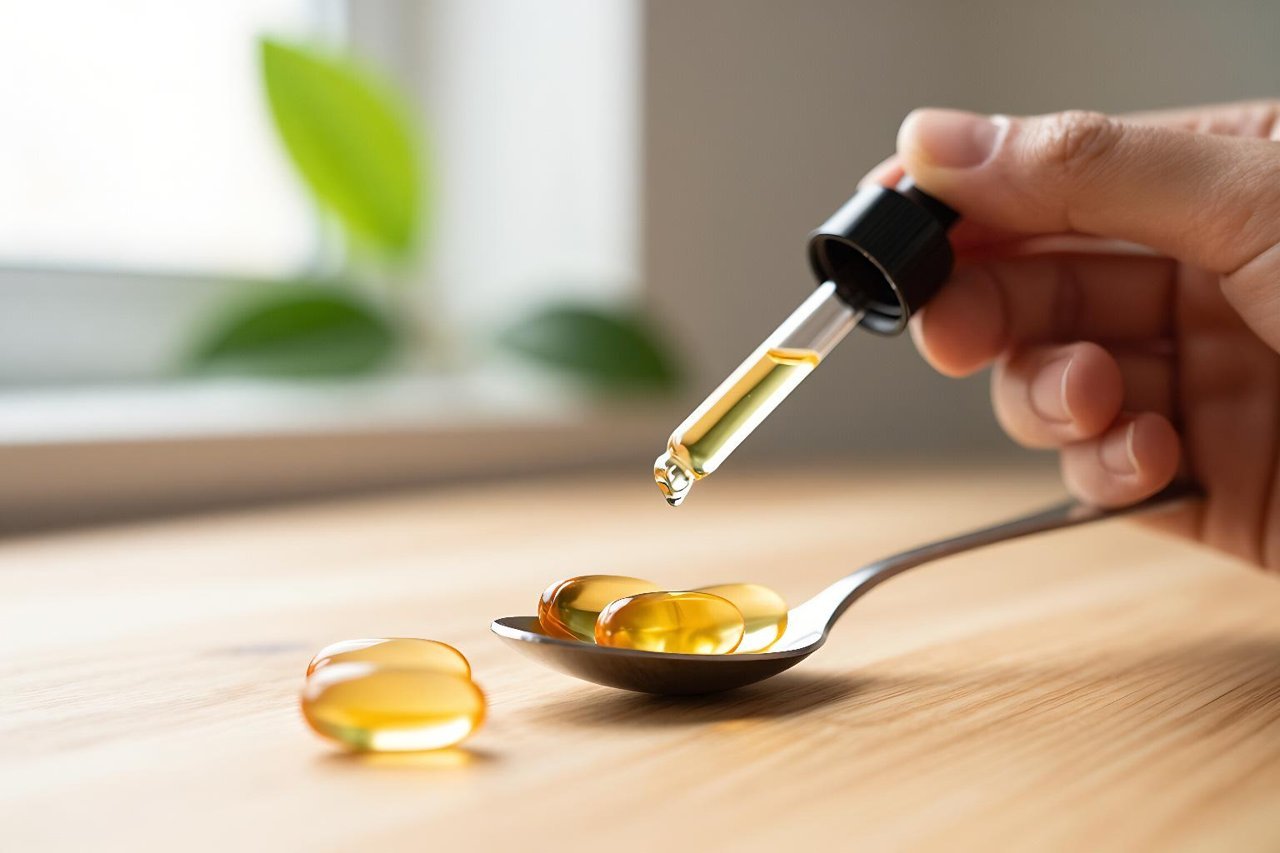
The format you choose affects how well you stick to the habit, how you adjust the dose and whether you can absorb the fat-soluble nutrient properly. Here’s what each format brings to the table.
- Liquid drops: Best for dose flexibility. You can often adjust from 200 to 2,000 IU by changing the number of drops. Drops also go into smoothies, yoghurt or a spoonful of honey. The cons are measurement errors and a greasy bottle that can leak in a bag.
- Softgels: Best for pre-measured daily convenience. Most softgels hold vitamin D in oil, which helps absorption. However, you can’t easily change the dose, and some shells use animal gelatin or soy-based additives.
- Tablets or dry capsules: Often cheapest and easy to store. But unless they are made with a lipid matrix or micellized vitamin D, they tend to be less well absorbed than oil-based formats. Dry forms may also contain microcrystalline cellulose or silicon dioxide, which are rarely an issue but can be hard to track.
- Sprays: Fine if you dislike swallowing and need a low dose. They deliver a quick pulse through the oral mucosa, but most sprays give only 500 to 1,000 IU per spray and require shaking. Doses can become inconsistent near the bottom of the bottle.
If you want to combine vitamin D with a fatty meal, softgels are a no-brainer. But if you are dosing children, drops give you far more control.
Dose: How Much Should You Actually Take?
Looking at supplement bottles is confusing because some products give 800 IU, others give 5,000 IU and a few go as high as 10,000 IU. For a healthy adult, 1,000 to 2,000 IU per day is normally enough to maintain vitamin D status. If you have tested low, your doctor might recommend a weekly dose of 50,000 IU for six or eight weeks, but that is not something to self-prescribe. Since vitamin D is fat-soluble, your body stores it and can build up to toxic levels over time.
One overlooked issue is hidden vitamin D in other daily products. Many multivitamins and some protein powders already provide D, so you could be unknowingly stacking doses. To avoid that, scan a multivitamin label and check its D content before adding a standalone supplement. Our practical multivitamin comparison can help you spot which formulas contain supplemental D and which don’t.
Look Closely at Carrier Oils and Additives
Vitamin D cannot work well without fat to dissolve it. That is why you’ll see coconut-derived MCT oil, olive oil, safflower oil or even flaxseed oil in most drops and softgels. Every carrier oil has its own fingerprint. MCT oil is flavourless and stable, but is a problem for anyone avoiding coconuts. Olive oil is popular and heart-healthy, but it can go rancid if the bottle is exposed to heat or light.
You should also ask whether extra ingredients are acceptable. Some brands add vitamin K2, which is useful for steering calcium into bones, but if you eat leafy greens such as kale or spinach, you don’t necessarily need it. Few brands add synthetic flavours or sweetener, especially for sprays, and that can make a product taste better but adds unnecessary chemicals.
If you already take fish oil or another omega-3 supplement, pay attention to the same kind of sourcing and extraction issues. A separate comparison of krill, algae and fish oil omega-3 supplements explains why the form of a nutrient changes how it behaves in your body.
Beyond Format: Your Daily Realities Matter
Making an ideal choice requires thinking about how you will consume this every day. If you are vegan, choose lichen-based D3 drops or softgels. If you travel a lot, pick a softgel version in a sturdy bottle, since glass droppers often leak at altitude. If you have kids or dislike swallowing pills, drops are the most flexible approach. If you already take a multivitamin, start by calculating the D you already get so your supplement won’t push you into unnecessary territory.
Whatever you select, take it with a meal that contains a reasonable amount of fat. An egg, a spoonful of nut butter or a yogurt at breakfast is enough to activate absorption. Taking a vitamin D softgel with a glass of water and nothing else cuts into its effectiveness.
Because your body’s needs change with age, skin tone, sun exposure and latitude, the best vitamin D supplement is not a single product but a combination of the right D3 source, a middle-range daily dosage and a format that you’ll actually remember. If you want a straightforward filter to apply to any bottle you hold in a store, our no-nonsense guide to picking the best vitamin D supplement condenses this into a few non-negotiable label requirements. Use that filter, check for third-party testing, and you’ll have a product that works just as well on paper as it does in your bloodwork.


