
Table of Contents
Most people don’t need another lecture about eating better. They need something that survives a Tuesday night when the fridge is half empty and everyone is hungry. Whole foods hold up in exactly that moment, which is why the payoff tends to stick.
Whole foods are the ones that still look like what they came from: vegetables, fruit, whole grains, beans, lentils, nuts, seeds, eggs, fish, plain yogurt, meat that hasn’t been reshaped into nuggets. The benefits of eating whole foods don’t come from one magic nutrient. They come from what these foods carry, what they leave out, and how your body handles the difference.
Nutrients Arrive in Packages Your Body Knows How to Use
A supplement label can list 500 mg of calcium. A cup of cooked collard greens hands you calcium along with vitamin K, potassium, magnesium, vitamin C, and fiber, all at once, in a form your gut has been handling for a very long time. That kind of bundle is hard to reproduce in a capsule.
Processing takes things away. Refining wheat into white flour strips out the bran and germ, and with them most of the fiber, vitamin E, and B vitamins, plus roughly a quarter of the protein. Fortification adds a handful of nutrients back. It doesn’t put back the rest.

Fiber is the piece supplements can’t copy
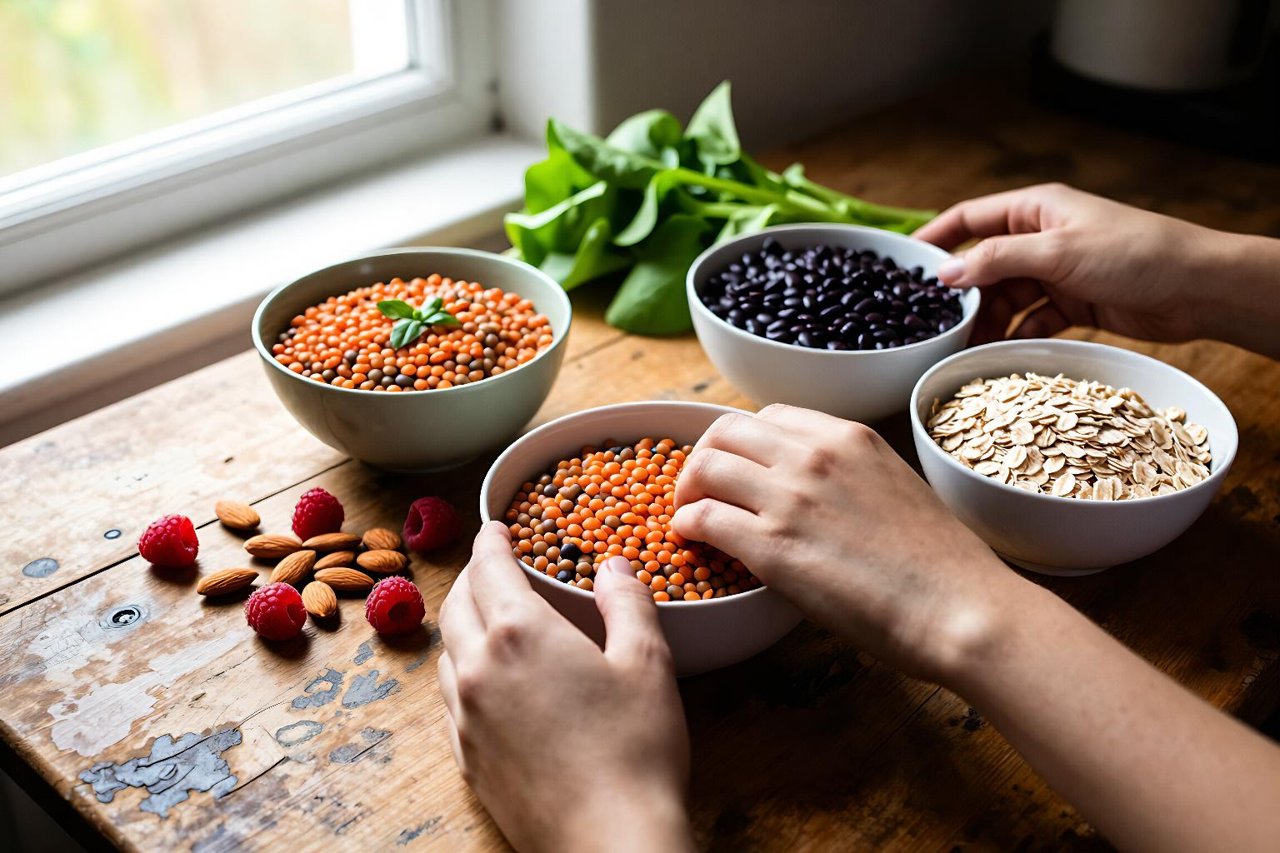
Adults need somewhere between 25 and 38 grams of fiber a day. Most of us land closer to 15. Closing that gap is less daunting once you see where fiber actually lives:
- 1 cup cooked black beans: about 15 g
- 1 cup cooked lentils: about 15 g
- 1 cup raspberries: 8 g
- 1 medium pear with the skin on: 5.5 g
- Half a cup of dry rolled oats: 4 g
- 1 ounce of almonds: 3.5 g
Hit three of those in a day and you’re basically done. Fiber also feeds the gut bacteria that produce butyrate and other short-chain fatty acids, which your colon cells use as fuel. No fiber gummy has managed to replicate that arrangement yet.
Steadier Blood Sugar, Steadier Afternoons
Pair a carbohydrate with fiber, protein, and fat and it enters the bloodstream slowly. Strip those away, as you do with white bread, sweetened cereal, and a lot of so-called protein snacks, and you get the familiar spike followed by the 3 p.m. slump. People who eat mostly whole foods often describe the change as less about having more energy and more about no longer losing it. No 2 a.m. wake-ups. No needing a second coffee just to reach lunch.
There’s lab evidence for the broader pattern. In a 2019 study from the National Institutes of Health, twenty adults lived on a research ward for four weeks and alternated between ultra-processed and unprocessed menus matched for calories, sugar, fat, fiber, and sodium. On the ultra-processed weeks they ate roughly 500 extra calories a day and gained about two pounds. On the unprocessed weeks they lost about two. Same nutrients on paper, different food on the plate. The researchers noticed people simply ate faster when the food was soft and heavily engineered.
Wins for Your Heart You Can Actually Measure
Blood pressure responds to the balance between potassium and sodium, and whole foods tilt that balance in your favor without any effort. A medium baked potato with the skin on carries around 900 mg of potassium. A banana has about 420 mg. A single frozen dinner can carry 700 to 1,500 mg of sodium before you’ve touched the salt shaker. Cooking from scratch quietly puts that number back under your control.
Soluble fiber does its own work. Oats, barley, beans, and apples bind bile acids in the gut, which pushes the liver to pull cholesterol out of your bloodstream to make more. A cup of cooked barley delivers about 6 grams of fiber and a measurable dent in LDL when it becomes a regular habit rather than a one-off. If you want somewhere concrete to begin, this real-world grocery list for heart health is a sensible place to build from.
Weight Management Gets Easier When You Stop Counting
Whole foods take longer to chew, hold more water, and take up more room on the plate for the same calories. A hundred calories of apple is a whole piece of fruit that takes several minutes to finish. A hundred calories of cookies is two bites. That gap shows up in how full you feel an hour later, and it compounds over a week.
Nobody is suggesting you never eat a cookie. The point is that when the default option is a pear, a bowl of lentil soup, or eggs on toast, you spend far less of your day negotiating with yourself. Appetite regulation stops being a willpower problem and becomes a side effect of what’s already in the kitchen.
Less Inflammation, Calmer Joints
Chronic low-grade inflammation is the thread running through a lot of what people call aging: stiff mornings, aching hands, stubborn joint pain. Diets heavy in refined oils, added sugar, and processed meat tend to feed that fire. Diets built on fatty fish, colorful produce, olive oil, nuts, and whole grains tend to quiet it. That’s why rheumatologists increasingly talk about food alongside medication rather than after it, and why eating for joint relief has become a practical conversation instead of a fringe one.
The effect isn’t dramatic in a single meal. Over months, though, it’s often the difference between reaching for ibuprofen twice a week and twice a month.
Protein From Real Food Holds Its Own
Four ounces of chicken breast gives you about 35 grams of protein. A cup of cooked lentils gives you around 18, plus 15 grams of fiber and a fistful of folate and iron. A cup of plain Greek yogurt lands near 20 grams and brings calcium and live cultures along for the ride. When you line up protein-rich foods side by side, the plant options close more of the gap than most people expect, especially when you eat them across the day rather than all at dinner.
Powders and bars have their place, usually convenience. But the comparison between whole foods versus powder, bars, and meal prep tends to favour the plate once you account for satiety, micronutrients, and the fact that a shake doesn’t keep you full until lunch.
What the Switch Looks Like in Practice
Nobody swaps their entire diet on a Sunday and sticks to it. Small, boring substitutions hold up far better:
- Swap instant flavored oatmeal for plain rolled oats with frozen berries and a spoon of peanut butter
- Swap a granola bar for a handful of almonds and an apple
- Swap jarred pasta sauce for canned crushed tomatoes, garlic, and olive oil
- Swap deli meat sandwiches for leftover roast chicken or a can of tuna
- Swap flavored yogurt for plain yogurt with honey and walnuts
- Swap soda for sparkling water with a squeeze of lime
Give each one two weeks before adding the next. Six of these changes reshape a grocery cart more than any cleanse ever will.
Build the Kitchen, and the Habits Follow
The most reliable predictor of what you eat on a Wednesday is what was in the fridge on Sunday. Stock the dozen items you’ll actually cook with and the decisions take care of themselves. A short, unfussy list of healthiest foods to eat every day covers most of it: eggs, oats, beans, frozen vegetables, canned tomatoes, olive oil, plain yogurt, nuts, a bag of citrus, onions, garlic, and whatever protein you’ll genuinely bother to cook.
None of this requires perfection. A diet that’s 80 percent whole foods and 20 percent everything else will still deliver most of the benefits described above, and it’s the version you can keep for thirty years. The goal isn’t a clean label. It’s a body that runs steadily, a heart that stays out of trouble, and a Tuesday night that doesn’t end with a drive-through.


