
Table of Contents
Ask ten people what a balanced diet looks like and you’ll get ten answers, most of them built around something you’re not allowed to eat. That framing gets the whole thing backwards. Building a balanced diet isn’t about shrinking your plate until it’s joyless. It’s about consistently getting enough of the things your body actually runs on, in a pattern you can still follow on a wet Tuesday in February when work ran late and nobody remembered to defrost anything.
Here’s the practical version: the numbers that matter, the shortcuts that hold up, and the parts most guides quietly skip.
What “balanced” actually means in practice
A balanced diet covers three layers, and people tend to obsess over one while ignoring the others.
- Energy: enough calories to support your activity, not so many that you’re gaining steadily without wanting to.
- Macronutrients: protein, carbohydrate and fat in proportions that keep you full, fuelled and recovering.
- Micronutrients and fibre: vitamins, minerals and plant fibre, which is where most diets quietly fall apart.
The reason this matters is that you can hit your calorie target perfectly on crisps and coffee and still be malnourished in the ways that show up as fatigue, poor sleep and constant hunger. If you want a broader grounding in food quality before fine-tuning numbers, this guide to healthy foods and nutrition without the drama covers the fundamentals well.

Start with the plate, not the spreadsheet
Before you weigh a single gram, use the plate method for a fortnight. It’s crude, but it’s accurate enough to fix most diets in about two weeks.
Picture a standard dinner plate. Half of it should be vegetables or salad. A quarter is a protein source, roughly the size of your palm. The final quarter is a starchy carbohydrate, about a cupped hand’s worth. Add a thumb of fat, whether that’s olive oil, butter, avocado or cheese.
That single habit tends to raise fibre, lower the energy density of your meals and stop the 4pm biscuit raid, because you’re actually full. If you eat this way three meals out of four, you’re already doing better than most people who track every macro.
Anchor each meal with protein
Protein gets the most attention for good reason. It preserves muscle while you lose fat, keeps you fuller than the equivalent calories from fat or carbs, and costs your body energy to digest.
The official minimum is 0.8g per kilo of bodyweight. That’s a floor set to prevent deficiency, not a target for someone who trains. If you’re active or over 50, aim for 1.2g to 1.6g per kilo, spread across meals rather than dumped into dinner.
Concrete portions, since vague advice helps nobody:
- 150g Greek yoghurt: about 15g protein
- Two large eggs: 12g
- 100g cooked chicken breast: 31g
- A standard tin of tuna: 25g
- 200g firm tofu: roughly 16g
Most people get plenty of protein at dinner and almost none at breakfast. Move 20g to the morning and hunger tends to drop noticeably by mid-afternoon. If you’re training hard and struggling to eat enough overall, these protein-rich foods for building muscle are worth building meals around.
Pick carbohydrates that do some work
Carbohydrate quality is the difference between a meal that holds you for four hours and one that leaves you hunting the snack drawer ninety minutes later. Oats, potatoes, rice, beans, lentils, wholemeal bread and fruit all bring fibre, vitamins and slow-release energy. White bread and sweets bring energy and little else, which is fine occasionally and unhelpful as a base.
Fibre deserves its own mention. Target 25g to 30g a day and you’ll feed your gut bacteria, steady your blood sugar and improve pretty much everything downstream. Beans, lentils, berries, oats, nuts and vegetables do the heavy lifting. This piece on foods linked to a longer, healthier life leans heavily on exactly these ingredients.
Fat: watch the amount, not the type
Fat carries flavour and fat-soluble vitamins, and it makes food satisfying. It’s also dense: one tablespoon of olive oil is around 120 calories, and a generous handful of almonds is 180.
Aim for most of your fat from olive oil, nuts, seeds, avocado and oily fish, with salmon or mackerel twice a week for omega-3s. There’s no need to fear butter or cheese, but they work better as seasonings than as staples.
Meal templates beat recipes
Rigid meal plans fail because they assume your week looks like the one you planned for. Templates survive contact with real life.
The formula is: protein + starchy base + two vegetables + a fat + something sharp or salty.
Chicken, rice, roasted peppers and courgette, olive oil, squeeze of lemon. Salmon, new potatoes, broccoli and green beans, butter, capers. Eggs, wholemeal toast, spinach and tomato, a little cheese, hot sauce. Once you can run that formula with whatever’s in the fridge, you’ve solved dinner for the rest of your life.
Where named diet patterns fit in
Whole dietary patterns can be useful scaffolding if you like structure. Mediterranean-style eating, which emphasises olive oil, fish, legumes, vegetables and wholegrains, has the strongest evidence base of any way of eating. That said, there are several versions of it and they don’t behave identically, so it’s worth reading a comparison of different Mediterranean diet meal plan styles before committing.
Low-carb, vegetarian and high-protein approaches can all be balanced. What matters is whether the pattern delivers enough protein, fibre and micronutrients, and whether you’d still be eating that way in a year.
Use your hands as a portion guide
You don’t need kitchen scales for everyday eating. Body-scaled measures are surprisingly accurate and they travel with you.
- Palm: a portion of protein
- Fist: a portion of vegetables
- Cupped hand: a portion of carbohydrate
- Thumb: a portion of fat
Larger people get larger portions automatically. Smaller people don’t have to eat like a bodybuilder. Adjust up or down by one hand per meal based on hunger and results.
Supplements cover gaps, not holes
No pill rescues a diet built on takeaways, but a few nutrients are genuinely hard to hit from food alone. Vitamin D between October and March in northern latitudes, B12 if you’re vegan, and iron if you’re a menstruating woman or an endurance athlete are the usual suspects. Requirements shift as you get older, too; this breakdown of vitamins for women by age, comparing multivitamins with targeted supplements is a sensible starting point before you buy anything.
A sample day that actually balances
Breakfast: 50g oats with milk, a handful of blueberries and 20g peanut butter. Around 18g protein.
Lunch: two eggs on wholemeal toast with spinach and tomatoes, plus an apple. Around 22g protein and 10g fibre.
Afternoon: Greek yoghurt with a small handful of walnuts.
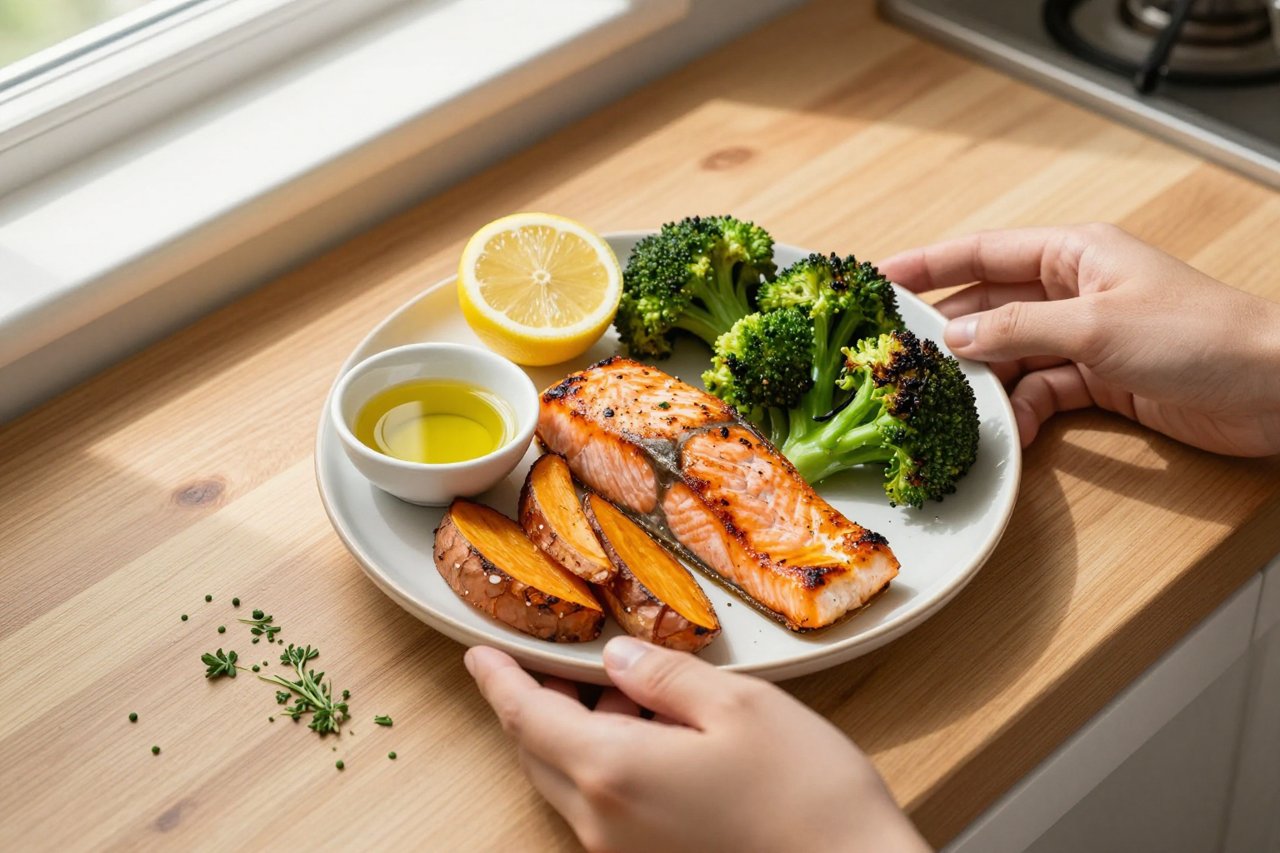
Dinner: 150g salmon, 200g new potatoes, a large pile of broccoli and green beans, olive oil and lemon.
That’s roughly 2,000 calories, 110g of protein, 30g of fibre and two portions of oily fish if you repeat the salmon later in the week. Nothing exotic, nothing requiring a special shopping trip.
Three changes worth making this week
Don’t overhaul everything. Pick one meal and upgrade it three times.
First, add a vegetable to breakfast. Spinach in eggs, tomato on toast, frozen berries in porridge. It’s the meal where most people’s produce intake sits at zero, and fixing it is easier than it sounds.
Second, buy two things you’ll actually cook. A bag of frozen mixed vegetables and a pack of chicken thighs or a block of tofu, depending on your preference. Frozen vegetables last, cost little and rescue a meal in six minutes.
Third, keep a snack that contains protein within arm’s reach. Yoghurt, boiled eggs, edamame, whatever you’ll genuinely eat. Hunger that arrives when your only option is a vending machine is where balanced diets go to die.
Give those three changes a fortnight. If your energy steadies, your digestion improves and you’re not thinking about food constantly, the balance is working. If it isn’t, adjust the protein and fibre upward before you change anything more drastic, because those two levers fix the majority of diets that feel off.


